
In this guide
A first wholesale iron-door order should establish a repeatable configuration, a complete packing record and a receiving process that identifies exceptions. Choose a small set of deliberate variations rather than a collection of unrelated samples.
Start with the iron and steel collection and use the distributor supply planning page to define the commercial discussion. Order quantities and mix should be confirmed for the actual proposal rather than assumed from a general wholesale label.
What should a first wholesale order establish?
Decide what the trial is intended to establish: design acceptance, finish selection, installation coordination or the practicality of a repeat supply arrangement. Select representative openings and document the reason for each configuration. Keep unnecessary variation out of the first brief.
For each door, identify the frame, leaf arrangement, decorative pattern, glazing, threshold and hardware. If alternatives are being compared, change a known item and keep the other specification fields visible. This makes the result useful for later purchasing decisions.

Complete the order checklist
| Record | Required trial-order detail | Acceptance reference |
|---|---|---|
| Door identity | Unique order line and opening reference | Approved door schedule |
| Handing | Active leaf, swing and viewing convention | Marked plan drawing |
| Materials | Frame, leaf and decorative components | Supplier component schedule |
| Glass | Appearance, composition and operation | Approved specification or sample |
| Finish | Color and proposed protective system | Sample reference and finish record |
| Hardware | Item identity, quantity and supply status | Agreed bill of materials |
| Packing | Door-to-crate relationship and labels | Packing list |
| Support | Reporting contact and required evidence | Written order procedure |
Keep the accepted documents together. A photograph can support this record, but it should not replace the dimensioned drawing or component list.
Resolve handing and hardware before production
Show the door in plan with the side from which it is viewed. On a double door, identify the active and inactive leaves and the intended locking arrangement. Avoid relying on a left-hand or right-hand abbreviation without agreeing the convention.
Confirm lock preparation, handles, hinges and threshold inclusions. If hardware will be purchased locally, exchange the relevant information before the door is made. Record the exact responsibility for preparing and fitting each item so that a missing component does not become an installation-day discovery.

Plan how the trial will be received
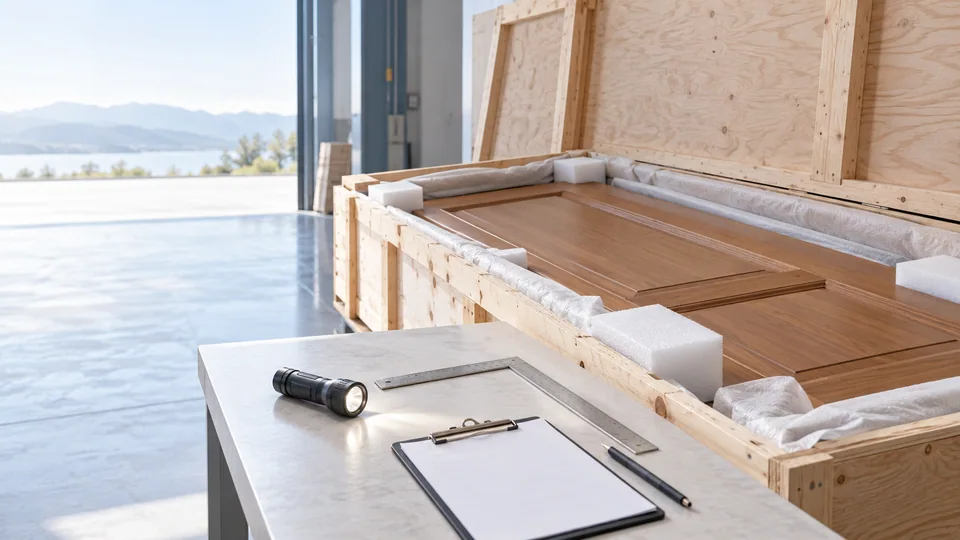
Ask for labels that connect crates, components and order lines. Confirm the information available before shipment, including packing details and agreed inspection records. Arrange suitable unloading and storage through the receiving team.
At receipt, compare the package count with the packing list and document visible condition. Keep concerns linked to the door identifier, photographs and delivery record. Use the quality and project requirements guide to agree what evidence should accompany a concern, and obtain product-specific instructions before attempting adjustments or repairs.
Turn the trial into a repeat-order decision
Set up a record with four outcomes: configuration matches, documentation complete, packaging reconciled and unresolved exceptions. A commercial trial succeeds when it reduces uncertainty for the next purchase; a good-looking sample alone does not settle hardware completeness or delivery handling.
Before arrival, nominate the person who records crate labels and the safe storage location. SDI’s steel-door storage guidance highlights moisture and handling as protection issues. Follow the actual supplied product’s instructions, especially for glazed or unusually heavy assemblies.
After inspection, compare each exception with its agreed reference and assign a resolution owner. Retain the exact accepted drawing, finish sample and hardware list as the reorder baseline. Expand the range only where those records remain usable; unresolved substitutions should not become the default for future stock.
Make the reorder a controlled decision
After the trial, record which configuration was accepted, which details need revision and what remains unresolved. Retain the approved finish reference, hardware identities and drawing revision. Ask the supplier how substitutions or later changes will be communicated.
Review the steel door corrosion planning guide when the trial includes exposed entrances. Include the intended location and care requirements in the repeat-order brief. A successful trial should produce a precise specification and a clear support process, not only an attractive photograph or an unqualified assumption that every future order will be identical.
Before you specify
Questions worth asking
Should every trial door use a different finish?
Only if finish comparison is the trial objective. If you are evaluating packing or installation coordination, too many simultaneous changes make the result harder to interpret.
Sources & further reading
About this guide
A practical starting point.
Use this guide to prepare your project brief and compare proposals. Construction details and installation requirements must be checked against the selected system and its approved documents.